
Spark eDiscovery Blog

eDiscovery in Real Life
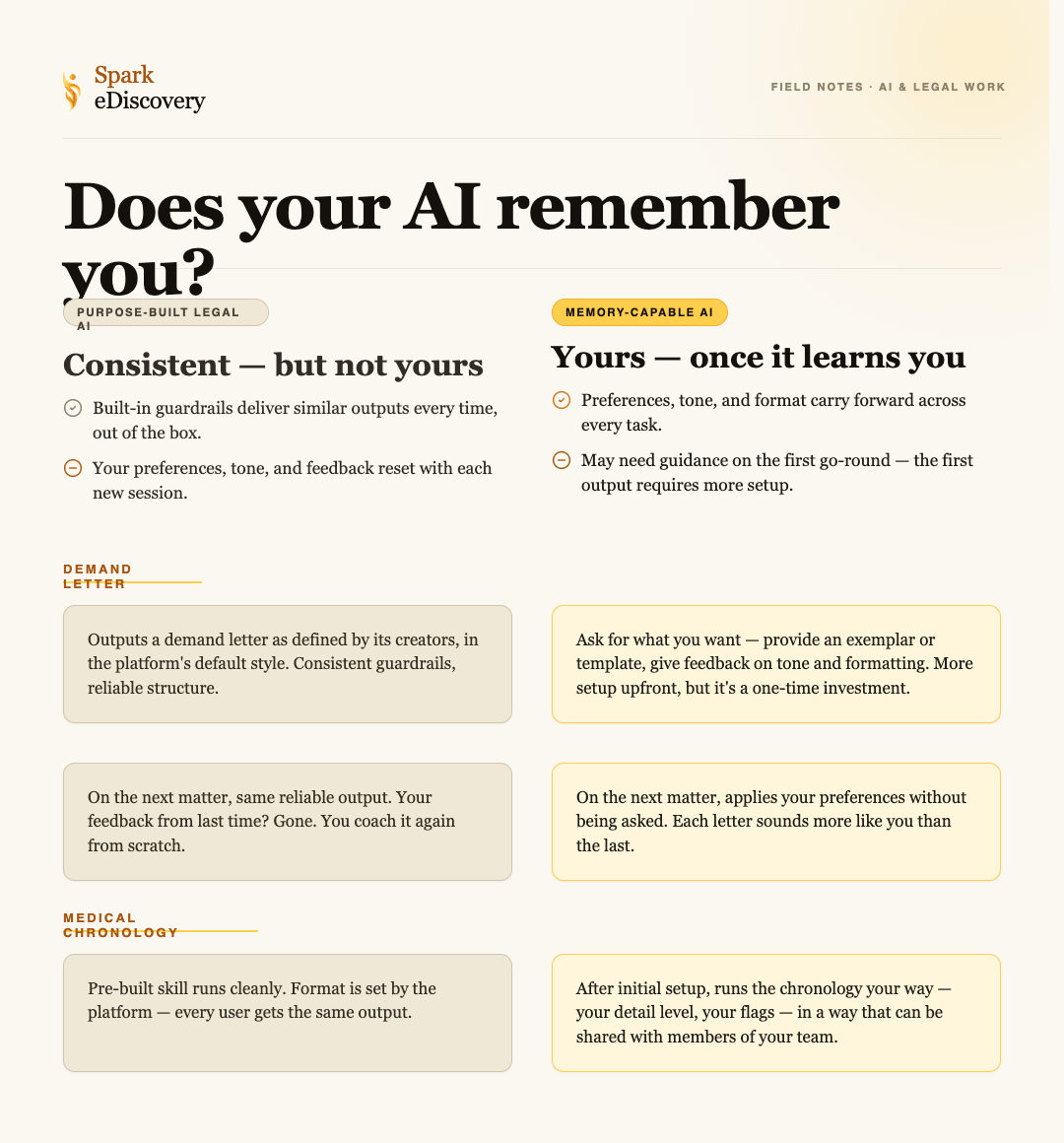
Legal practice should use tools that learn from you.
Some questions you should consider asking when adopting a new AI solution:
Who defines the output? If “build a medical chronology” is a pre-loaded skill built by the platform, can user feedback be incorporated? I found that in CoCounsel, it disregarded formatting and structure instructions in my prompt because I had called upon its “generate questions” skill, which determined the output.
Does it empower you to check its work? I often reflect on this question in considering Everlaw’s AI coding tools vs. RelativityAIR for Review — Relativity has defined the defensible workflow and walks you through it, while Everlaw is not prescriptive and may empower overconfidence. Does the AI platform have a spot-checking mechanism built in, such as for medical records? Is it easily linking you its sources and cites, and giving you guidance on where it drew some iffy inferences? In a structured request for feedback, the AI should be building its understanding of the case, your preferences, and the underlying documents. You want to know whether corrections from one session inform the next one, and how. What will happen when the task falls to your least experienced associate?
What makes you special as an attorney is your judgment and experience. Your approach to letters, memos, motions, memory aids, and chronologies are extensions of that experience.
Some of the purpose-built legal platforms have to relearn your preferences and tone on every. single. task. That truly limits their usefulness, because they are forever writing their creators' demand letters, rather than yours.

Explore Niche Markets for Your Legal Career
I was happy to write for the American Bar Association’s GPSolo Magazine this month! The issue covered alternative legal paths like academia, tax, HR, ADR, and eDiscovery.

DOJ failed to properly redact the Epstein files
DOJ’s careless release of victim information in the Epstein Files was easily avoided. They knew better, and so should you. Here is how to avoid making the same mistakes with redactions.

In 2025, Let’s Make Active Learning a Part of Your Team
Happy New Year! It is 2025, and it’s time to use the best AI available, usually for little cost, to assist all document reviews. It is time to apply Active Learning to every review project, every time.


Avoidable DOJ data leak shows need for better safeguards
Say the case’s “silver bullet” document is a chat between defendants. Figuring out whether this is a relevant and responsive document requires understanding the abbreviation, the timing of the conversation, the roles of the participants, and perhaps the anxiety conveyed by the emoji. A reviewer in the last days of the review may have developed this context and will recognize the importance, but what if the chat surfaced on day one of the review? It might not have been identified as key … or it might not have been identified as responsive at all.
Should we change the review process to account for this disconnect? This is a conversation that the tech-focused side of the aisle often misses, and an ongoing one. Here are a few of my thoughts on how we can ensure short messages don’t fall through the cracks.


The “Perfect Date”
Just in time for Valentine’s Day, Spark brings you: The Perfect Date? An small adventure in Metadata.

Avoid getting an “Undifferentiated Pile” production
You served 10 Requests for Production on the opposing party under Fed. R. Civ. P. 34.
Finally, after months of harassment, they have given you a single, 500-plus-page PDF file, with Bates-stamped pages.
You're going through it, and both you and your computer are losing the will to live.
Sound familiar? Productions like this are the norm in smaller cases and certain practices. But such low-tech production of ESI (electronically-stored information) in discovery almost certainly violates Fed. R. Civ. P. 34.

Privilege, Attachments, and an ESI Protocol Surprise
In a recent case, opposing counsel added a new term to the ESI Protocol that I had not seen before. It required us to separately log each document withheld for attorney-client privilege, including email attachments, and provide an independent basis for privilege for each document.
This term threw me off.

Why can’t my client just forward me the relevant emails for discovery?
Is your client’s CEO leery about letting attorneys go digging through his inbox? We would be too. But in all but the smallest cases, it is improper to leave it up to the client to decide where to look and what is responsive.
![Dance with the [eDiscovery vendor] that brought you.](https://images.squarespace-cdn.com/content/v1/62c72a1ad6f918292d8698e1/1665101845486-TZPUARGQLVUE84LSVFDB/Distracted+Boyfriend+meme.jpeg)
Dance with the [eDiscovery vendor] that brought you.
Despite good-faith efforts from the new vendor and the in-house technical team from the old firm, it took me months to iron out the issues that this seemingly-simple decision introduced. Unless the situation with your existing vendor is untenable, don’t change horses mid-stream!

Déjà views? A brief look at methods for cutting down on duplicates.
“We have seen so many of the same document! Can’t we deduplicate?”
Yes, but!